Next-Gen Anti-Theft Features for Displays

Protecting high-value merchandise inside display cases presents a significant retail challenge. The solution for 2025 is a multi-layered security strategy. This approach enhances the customer experience by securing the premium presentation. It integrates robust physical protection for the display case with smart technology. These advanced anti-theft features create a secure display environment. The growing need for such security features is clear from market growth projections.
| Metric | Projected CAGR | Period |
|---|---|---|
| Retail Security | 4.32% | 2025-2035 |
| Retail Security | 7.20% | 2024-2032 |
This focus on advanced security for display cases ensures a better customer experience while safeguarding assets.
THE EVOLVING THREAT LANDSCAPE:
Understanding the enemy is the first step toward effective defense. Modern retail security must contend with threats that are faster, more organized, and sometimes originate from within. A secure merchandise display requires a strategy that addresses these specific challenges.
MODERN 'SMASH-AND-GRAB' TACTICS:
Smash-and-grab robberies rely on speed and destructive force. Thieves execute these attacks in minutes, using basic tools like hammers and crowbars to shatter a glass display case. These incidents show a statistical increase of about 10% during warmer months and also spike during the holidays. The goal is to overwhelm a retail location, break into the display, and escape before law enforcement can respond. This tactic directly targets the physical vulnerability of any display case holding high-value items.
ORGANIZED RETAIL CRIME (ORC):
Organized Retail Crime (ORC) presents a more calculated threat. These are not random acts but coordinated efforts by sophisticated groups. They use advanced methods to circumvent store security measures and steal from a retail display.
Common ORC Tactics Include:
- Using foil-lined "booster bags" to block security tag sensors.
- Switching barcodes to confuse self-checkout systems.
- Creating group distractions to divert staff attention from a high-value display.
- Coordinating "flash mob" thefts online for rapid, overwhelming strikes.
These groups exploit weak prosecution and use online marketplaces to quickly sell stolen goods, making ORC a lucrative criminal enterprise.
THE RISK OF INSIDER THREATS:
One of the most damaging threats comes from within the organization. According to the National Retail Federation, internal or employee theft contributes to over 28.5% of all retail shrinkage, with some reports placing the figure as high as 40%. Employees have trusted access to inventory and the display floor. This unique position allows them to bypass external security protocols, making insider collusion a critical vulnerability. Protecting a valuable display involves not only external security but also robust internal controls.
FORTIFYING RETAIL DISPLAY CASES:
The first line of defense against theft is the physical strength of the retail display cases themselves. A strong physical structure deters criminals who rely on speed and force. Modern display cases now incorporate advanced materials and engineering. This approach transforms a simple glass box into a secure vault for premium merchandise. The goal is to make the display case too difficult and time-consuming to breach.
ADVANCED GLAZING AND MATERIALS:
Traditional glass display cases are an easy target for smash-and-grab attacks. Today’s secure display cases use advanced glazing to resist high-impact force. Manufacturers often use polycarbonate laminates and ballistic-grade glass. These materials can withstand repeated blows from hammers or crowbars. This robust protection is essential for any jewelry display case.
Leading manufacturers design retail display cases with both security and aesthetics in mind.
- PFI In-Store, through its Jahabow brand, offers durable and elegant display cases with security features like reinforced glass.
- L.A. Darling creates custom retail security displays that protect high-value items like jewelry on the sales floor.
These companies provide specific models for different retail needs. Options like the FD-20 High Security Display Counter and the FD-45 High Security Display Corner show the industry's focus on specialized protection. These display cases feature reinforced frames that anchor the glazing, making the entire case a formidable barrier.
NEXT-GEN LOCKING MECHANISMS:
A strong case is only as secure as its lock. Criminals often target weak locking mechanisms. Next-generation locking systems provide a critical layer of security. These systems move beyond simple key locks to offer more sophisticated anti-theft features. High-security locks are now a standard for any premium jewelry display case.
Note: Modern locking systems integrate technology to create active deterrents. For example, alarmed locks from providers like Myriad trigger an alert if tampering is detected. This feature adds an immediate response capability to the physical security of the display.
Other advanced locking systems include:
- Biometric Locks: These locks use fingerprint recognition. They grant access only to authorized staff. This greatly reduces the risk of internal theft.
- Timed-Release Locks: These locks can only be opened at specific, pre-set times. This prevents unauthorized access outside of business hours.
- Tamper-Proof Fixtures: These are designed to prevent any unauthorized removal of the locking mechanism itself.
These security features make it much harder for thieves to quickly access the contents of a display case.
PROTECTING INDIVIDUAL JEWELRY ITEMS:
Securing the entire case is vital, but protecting individual items adds another powerful layer of security. This is especially important for countertop displays where customers interact more closely with jewelry. Smart devices now secure each piece of jewelry on the display. These devices allow for an attractive presentation while ensuring each item is protected. A jewelry display case with individual item security offers the best of both worlds.
These systems often use tethers or sensor-equipped stands. If a thief tries to steal a piece of jewelry, an alarm sounds. This technology is crucial for high-traffic retail environments. The table below shows different security models for various retail scenarios.
| Scenario | Recommended Model | Features | Notes |
|---|---|---|---|
| Free try-on with alarms | WDC1006 | Try-on + auto return + charging + alarm | Best for mid-to-high traffic |
| Lockable metal aesthetic | WRC1006 | Key lock, lower profile presence | No internal recoiler, no alarm |
| Budget, low-risk coverage | WEC1006 | Spring cord with charging | No auto return; manual tidy |
| Entry level, very low risk | WSA03 | Clip-sensor band holder | Basic display and security |
These devices offer features like internal steel-core recoilers for auto-return functionality and integrated electronic alarms. This level of security for individual jewelry items makes a countertop display both interactive and safe. It ensures the presentation of the jewelry remains excellent while the risk of theft is minimized. Many jewelry display cases now integrate these systems directly into their design.
SMART ANTI-THEFT FEATURES:
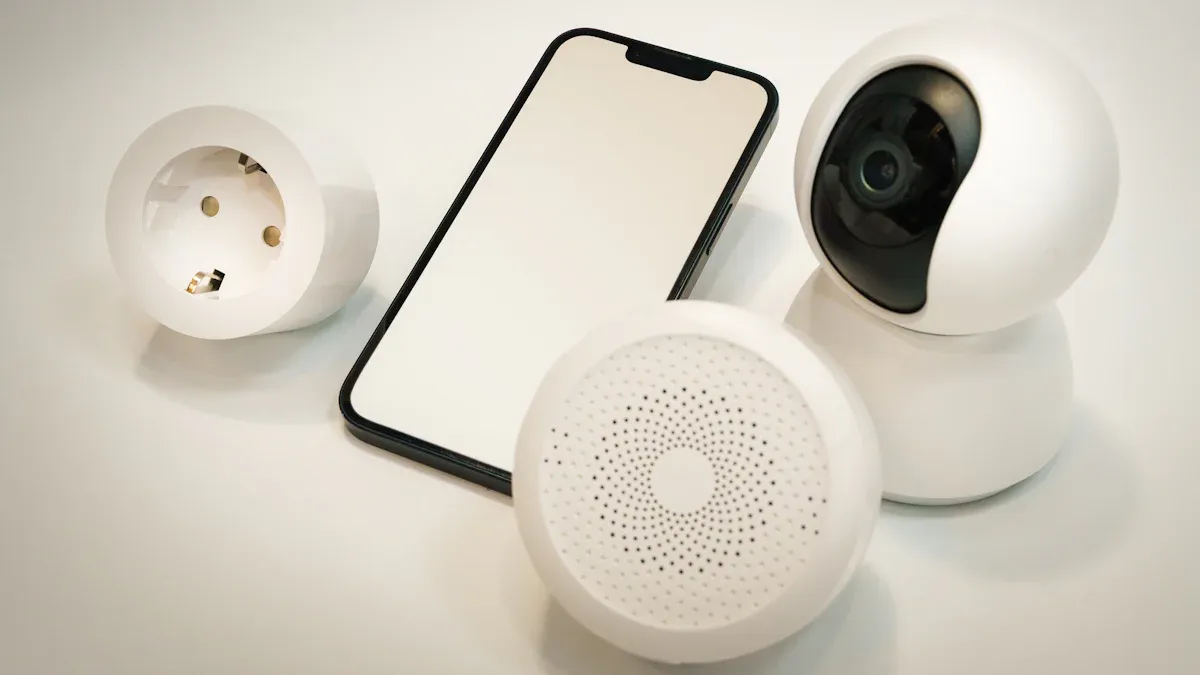
Physical barriers slow down criminals, but smart technology makes a display case an active participant in its own defense. Integrating intelligent anti-theft features transforms a static box into a responsive security asset. This approach uses the Internet of Things (IoT), real-time tracking, and interactive elements to create a formidable defense. These security features protect merchandise while enhancing the premium retail experience.
REAL-TIME IOT SENSOR ALERTS:
Modern retail display cases now use a network of IoT sensors to detect threats instantly. These sensors act as a digital nervous system for the display case. They can identify specific types of attacks and trigger immediate alerts. This proactive security is essential for protecting high-value items.
Two primary types of sensors are highly effective for display cases:
- Vibration or Shock Sensors: These devices, like the Abode Vibration Glass Break Sensor, attach directly to the glass. They detect the physical shock and energy from a direct impact, such as a hammer blow. This makes them ideal for sensing the initial moments of a smash-and-grab attack on a jewelry display case.
- Acoustic Glass-Break Sensors: These sensors listen for the unique sound profile of shattering glass. Advanced models from brands like Honeywell use processors to analyze both the low-frequency "thud" of an impact and the high-frequency "shatter" sound. This dual analysis reduces false alarms from everyday noises.
Note: When a sensor detects a threat, it does not just sound a local alarm. It sends a signal through a cloud-based platform like AWS IoT Core. Using protocols like MQTT, the system instantly pushes notifications to mobile devices and central monitoring stations. This allows security staff to receive live alerts, view camera feeds, and respond in seconds, no matter their location.
SMART JEWELRY DISPLAY CASE TECH:
The evolution of the jewelry display case goes beyond simple alarms. Companies are now creating fully integrated smart display cases that merge security with an enhanced customer presentation. Leading manufacturers like RONRUN and E Plus Showcases design intelligent solutions that make the display itself a key part of the retail strategy. This technology turns a standard countertop display into an interactive experience.
These smart display cases often include:
- Integrated Digital Signage: A jewelry display case can feature built-in LCD screens. These screens can show videos of a gemstone’s origin or a craftsman at work. This enriches the customer's connection to the jewelry.
- Dynamic Backgrounds: The display background can change to match a new collection or promotion. This creates a fresh and engaging visual presentation.
- Personalized Connectivity: The display can connect with a customer's mobile device. This allows for personalized information and a more immersive shopping journey.
This approach ensures the security of the jewelry inside the case does not detract from its beauty. Instead, the technology enhances the entire display.
RFID AND NFC ITEM TRACKING:
Protecting the case is important, but tracking each individual item offers the highest level of security. Radio-Frequency Identification (RFID) and Near Field Communication (NFC) technology enable real-time inventory management at the item level. This is especially critical for small, high-value goods like jewelry.
Retailers attach a tiny RFID tag to each piece of jewelry. RFID readers, often concealed within the countertop or the display cases themselves, continuously scan for these tags. This system provides a live, accurate count of every item on display. If a piece of jewelry is removed from the case without authorization, the reader immediately detects its absence and triggers an alarm. This allows staff to address a potential theft in real time, not hours later during a manual count.
However, implementing this system has challenges.
- Cost: The initial investment in readers, tags, and software can be significant for a retail business.
- Interference: Multiple readers operating in a dense retail environment can sometimes interfere with one another, a problem known as "reader collision."
- Staff Training: Employees require proper training to manage the new workflow and troubleshoot the system effectively.
Despite these hurdles, the benefits of precise, real-time tracking make RFID a cornerstone of modern anti-theft features for high-value merchandise display cases. It provides unparalleled control over every single piece of jewelry on the countertop.
AI-POWERED SURVEILLANCE:
Smart technology gives surveillance systems the power to think. Artificial intelligence acts as a "force multiplier" for retail security. It transforms standard video cameras from passive recorders into active guards for every display. AI automates alerts and accelerates video searches, making the protection of a display more efficient. This technology helps retail staff address threats to a merchandise display in real time.
BEHAVIORAL ANALYTICS:
AI-powered systems analyze video feeds to identify suspicious behaviors near a valuable display. The software learns to recognize actions that often precede theft. This allows for proactive intervention before a crime occurs. The system can detect many subtle actions.
Suspicious Behaviors AI Can Detect:
- Individuals lingering too long near a jewelry display.
- People placing items from a display into personal bags.
- Specific gestures that indicate a potential threat to a display.
When the AI identifies these patterns, it sends an immediate alert to security personnel. This enhances the overall security of the retail environment.
FACIAL RECOGNITION INTEGRATION:
Facial recognition adds another layer of intelligence to a security system. It can identify known offenders when they enter a store or approach a sensitive display. This allows staff to monitor the individual closely. However, this technology faces significant legal and ethical debates. Groups like the ACLU have raised privacy concerns in the United States. The European Union also has strict regulations on its use. Retail businesses must carefully consider these issues before implementing such a system for display protection.
CENTRALIZED ALARM SYSTEMS:
Modern security relies on integration. A centralized system uses AI as an "integrative glue" to connect all security components. It links IoT sensors on a display case, AI cameras, and electronic locks into a single, coordinated platform. This creates a unified loop of perception, recognition, and action. For example, if a sensor on a jewelry display is triggered, the system can:
- Instantly focus the nearest camera on the display.
- Use AI to analyze the live video feed for threats.
- Notify a central monitoring station and staff mobile devices.
This seamless connection makes the entire security network for the retail display faster and more effective.
OPERATIONAL SECURITY AND STAFF PROTOCOLS:
Advanced technology provides powerful tools, but a vigilant and well-trained staff forms the foundation of effective retail security. Human oversight is crucial for protecting any premium display. Retailers must develop comprehensive protocols that empower employees to become an active part of the defense strategy for every display. This approach addresses the critical human element in loss prevention.
STAFF AWARENESS TRAINING:
Staff training transforms employees from sales associates into security assets. A robust training program teaches staff to identify high-risk behaviors and suspicious activities near a jewelry display. This includes recognizing individuals who linger too long or show unusual interest in the display cases.
Effective training programs cover key areas:
- Loss Prevention Techniques: Staff learn proper product handling and how to report suspicious actions.
- Conflict Resolution: Employees gain skills to de-escalate tense situations, balancing security with a positive customer experience.
- Emergency Response: Clear procedures for robberies or other emergencies ensure a coordinated and safe reaction.
This education helps create a secure environment while maintaining a welcoming atmosphere for every customer.
SECURE HANDLING PROCEDURES:
Strict protocols for handling high-value merchandise are essential. These procedures minimize opportunities for theft when items are outside of locked display cases. When showing a piece of jewelry, staff should follow a clear set of rules to protect the item.
- Assist one person at a time.
- Show only one piece of jewelry from the display at a time.
- Lock the display cases immediately after removing or returning an item.
- Examine the jewelry with a loupe before and after the presentation.
- Never leave merchandise or the showroom unattended.
These steps create a controlled and secure interaction, protecting the jewelry during its most vulnerable moments.
DISPLAY LIMITATION STRATEGIES:
Retailers can significantly reduce potential losses by limiting the amount of jewelry on display. This strategy minimizes the impact of a smash-and-grab theft. Instead of filling display cases, stores can create a more curated presentation. This enhances the perceived value of each item on display. Data shows that combining lockable display cases with other technologies is highly effective. For example, some retailers have seen theft reductions of up to 50% by implementing secure display cases. This focused approach to the display experience protects assets without harming sales.
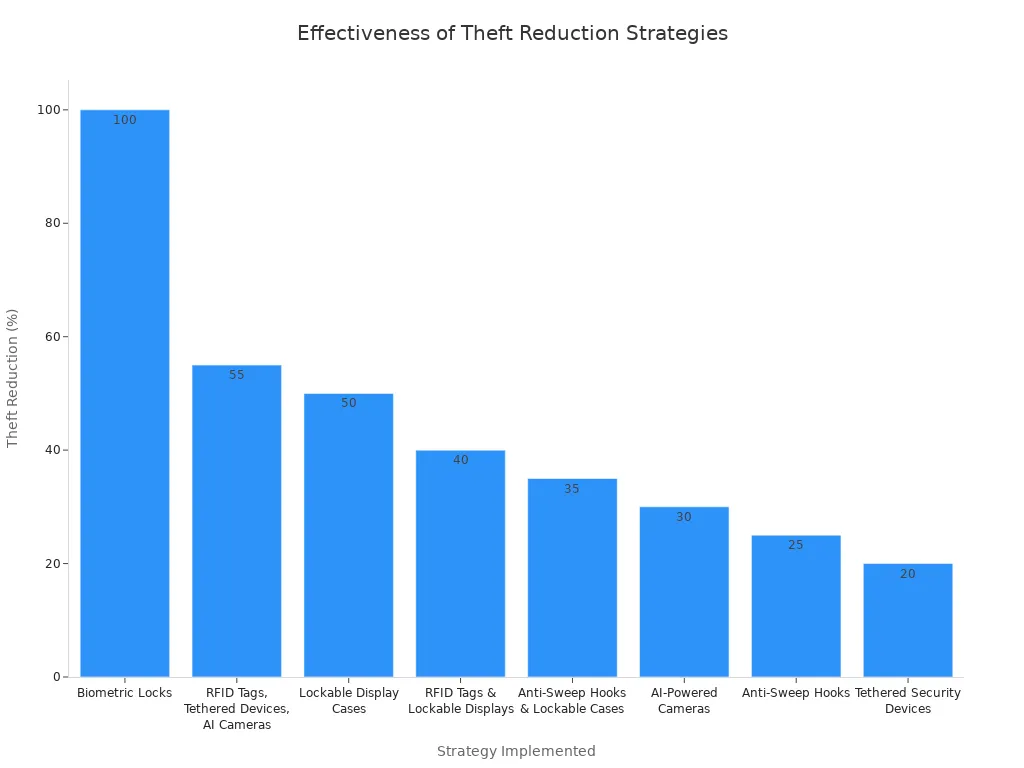
Effective display security merges physical barriers, smart technology, AI intelligence, and staff protocols.
This integrated security creates a formidable defense for any display. It protects the display from diverse threats like smash-and-grabs and internal theft. Investing in these next-gen anti-theft features protects a premium display. This strategy also enhances the customer experience, ensuring a positive interaction with the display for every customer. The right approach secures the display.
FAQ
What is the single most effective anti-theft feature for a display?
A multi-layered strategy is most effective. It combines physical hardening, smart IoT sensors, and AI surveillance. Relying on a single feature creates vulnerabilities. A comprehensive system provides the strongest defense for any high-value display.
How does AI improve display case security?
AI transforms cameras into proactive guards. It uses behavioral analytics to detect suspicious actions near a display. The system sends real-time alerts to security staff. This allows for immediate intervention before a theft occurs, protecting the merchandise inside the display.
Can strong security hurt the customer experience?
No, modern security can enhance the customer experience. Smart display cases use integrated digital screens and interactive elements. This technology creates an engaging presentation for the jewelry. It secures the items without creating a negative or restrictive feeling for the customer.
Why is staff training still important with advanced tech?
Technology supports security, but trained staff are essential. Employees learn to spot suspicious behavior and follow secure handling protocols. Their vigilance forms the foundation of any successful loss prevention program, making them a critical part of protecting every display.