Li-Ion Battery Charging Best Practices for 2025


You can maximize the safety and performance of your li-ion battery by following the latest li-ion battery charging best practices. Always stay within the recommended voltage, use overcharge protection, and adopt safe charging habits. Recent advances in battery technology, such as safety reinforced layers and improved charging protocols, have proven to reduce risks like overheating and extend battery life. As the use of li-ion batteries grows in everyday devices, you need to keep your charging routine up to date for the best results.
Charging Importance
Safety & Performance
You play a key role in keeping your devices safe by following the best li-ion battery charging practices. Charging your battery the right way helps prevent dangerous incidents. Many recent studies show that using optimized charging protocols, such as stepwise fast charging, reduces the risk of lithium plating. This process can cause short circuits and fires. Fast charging at mild low temperatures also lowers the chance of battery failure and improves safety.
Tip: Always use overcharge protection features. These systems cut off charging when the battery reaches its safe voltage. Overcharge protection prevents overheating, swelling, and even explosions.
Here are some important facts about li-ion battery safety and security:
- Optimized charging protocols reduce lithium plating, a major safety hazard.
- Fast charging does not always harm thermal stability, especially in LiFePO4 batteries.
- Proper charging strategies lower the risk of thermal runaway, which can cause fires.
| Source Name | Type of Evidence | Description and Relevance |
|---|---|---|
| EPRI Battery Energy Storage System (BESS) Failure Incident Database | Incident Database | Tracks battery failure incidents and root causes. Widely used for safety analysis. |
| Levin Simes LLP Reports | Legal and Investigative Reports | Shares statistics on battery fires, injuries, and deaths. Highlights consumer safety risks. |
| Scientific Reviews (e.g., Energy Reviews) | Academic Literature | Analyzes hazard characteristics, fire risks, and safety advancements in li-ion batteries. |
Major cities have reported hundreds of battery fires in recent years. Overcharge and lack of protection are leading causes. You can avoid these risks by using devices with built-in overcharge protection and following safe charging habits.
Battery Life
You can extend your battery’s lifespan by using correct li-ion battery charging methods. Battery management systems (BMS) and overcharge protection help balance cells and control charging. These systems keep battery capacity stable and prevent early aging. Machine learning tools now predict battery health and help you avoid overcharge or deep discharge, which can shorten battery life.
Keeping your battery between 20% and 80% charge, storing it in cool, dry places, and avoiding extreme temperatures all help maintain battery capacity. Smart cycling and steady current charging can increase battery life by up to 38%. New charging methods use advanced models to adjust current and reduce damage, extending battery life by almost 50%.
Note: Overcharge protection is not just for safety. It also keeps your battery healthy and strong for longer use.
By following these li-ion battery charging best practices, you protect your device, improve safety, and get the most out of your battery.
Maximum Voltage
Charge Voltage Limits
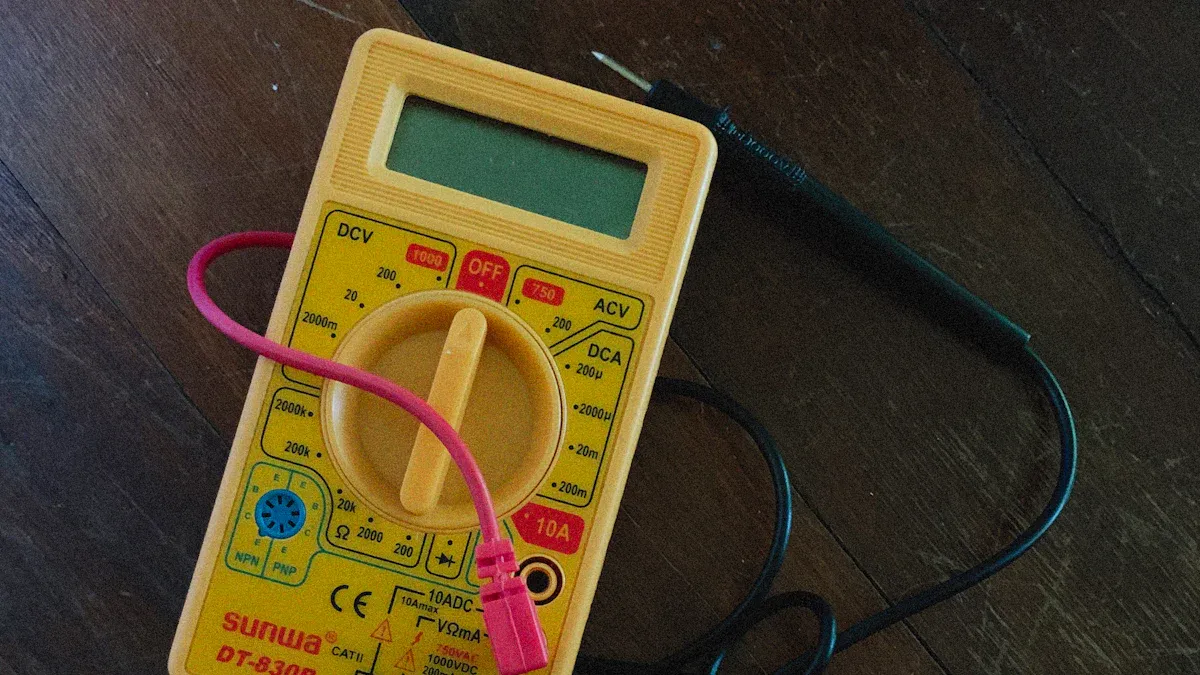
You must pay close attention to the charge voltage when charging your li-ion battery. The industry standard for maximum voltage in 2025 is 4.2 volts per cell. This value gives you the best balance between safety, battery life, and performance. Most classic cobalt-based li-ion cells use this voltage as their upper limit. Some newer batteries with special coatings or additives can handle up to 4.35 or even 4.4 volts, but these are not common in everyday devices. For most users, 4.2 volts remains the safest and most reliable choice.
Tip: Always check your device manual for the correct voltage limits. Using the wrong setting can damage your battery or reduce its lifespan.
You should also know about voltage tolerance. Modern chargers keep the voltage within ±50 millivolts (mV) of the target. This small range helps protect your battery from overcharging or undercharging. The charging process uses a constant current until the battery reaches the maximum voltage. Then, it switches to constant voltage, letting the current drop until charging stops. This method helps you get the most out of your battery capacity while staying safe.
Here is a table that shows the accepted voltage limits for different types of li-ion batteries:
| Battery Chemistry / Type | Nominal Voltage (V) | End-of-Discharge Voltage (V) | Max Charge Voltage (V) | Notes |
|---|---|---|---|---|
| Cobalt-based Li-ion (LCO) Classic | ~3.6 | 2.8 – 3.0 | 4.2 | Standard full charge voltage |
| Cobalt-based Li-ion (Marketing) | ~3.7 | 2.8 – 3.0 | 4.2 | Slightly higher nominal voltage for marketing |
| Modified LCO with additives | ~3.8 | 2.8 – 3.0 | 4.35 | Needs higher cutoff voltage for full capacity |
| Modified LCO with additives | ~3.85 | 2.8 – 3.0 | 4.4 | Higher voltage, shorter cycle life |
| Lithium Iron Phosphate (LiFePO4) | 3.2 – 3.3 | N/A | N/A | Different chemistry, incompatible charging profile |
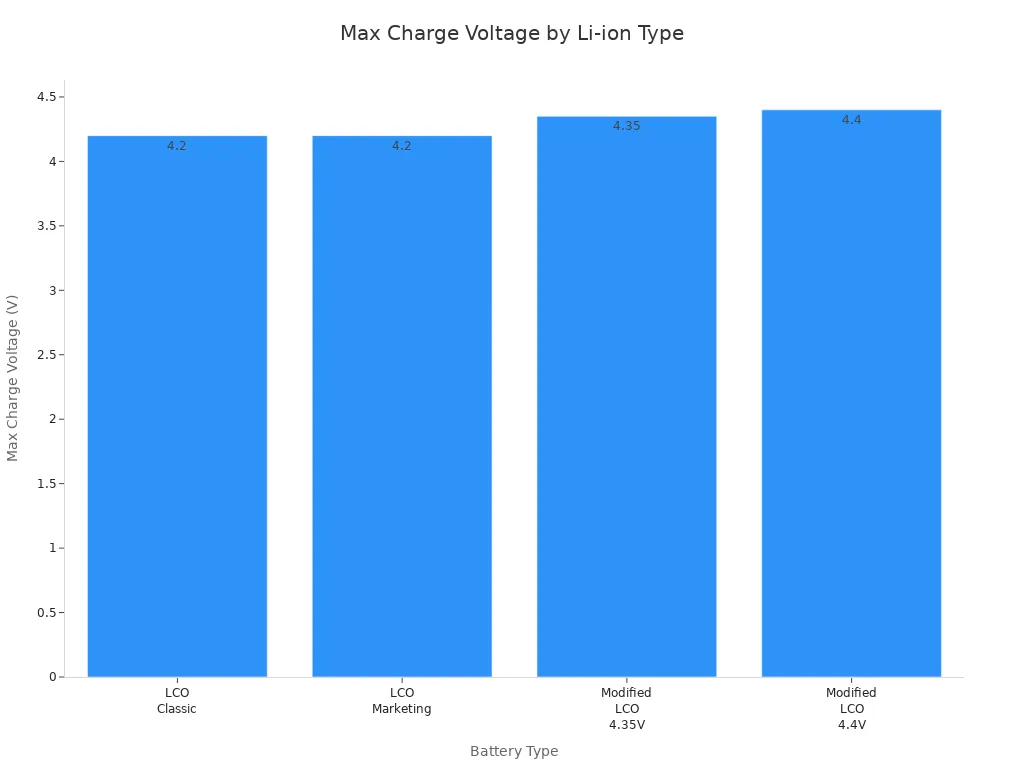
You should always respect these voltage limits. Charging above the recommended charge voltage can cause serious problems. Even a small increase, such as charging to 4.3 volts instead of 4.2, can lead to faster battery wear and safety risks. The maximum voltage is not just a suggestion—it is a rule you must follow to keep your battery safe and healthy.
Risks of Overvoltage
Charging your battery above the maximum voltage brings many dangers. When you exceed the voltage limits, you risk overheating, swelling, and even fire. Overvoltage causes lithium plating on the anode, which can create short circuits inside the battery. This process also leads to gas buildup, which increases pressure and may cause the battery to puff up or burst.
- Overcharging above 4.2 volts per cell can cause the battery to lose capacity quickly.
- The battery may degrade faster, reducing the number of times you can recharge it.
- Gas generation inside the cell increases, which can lead to leaks or explosions.
- The battery may enter thermal runaway, a dangerous chain reaction that can cause fire.
You should also know that overvoltage speeds up chemical reactions inside the battery. These reactions produce gases like carbon monoxide and methane. If the pressure gets too high, the battery may vent these gases or even catch fire. Manufacturers design protection circuits to disconnect the battery if the voltage goes above safe limits. These circuits use control chips, switches, and sensors to keep you safe.
Alert: Never use a charger that does not match your device’s voltage limits. Using the wrong charger or ignoring the maximum voltage can cause permanent damage or create a safety hazard.
Manufacturers recommend that you minimize the time your battery spends at peak voltage. Floating or trickle charging at 4.2 volts is not safe for li-ion batteries. Charger chips do not support this mode because it increases the risk of fire and reduces battery capacity. Floating at 4.0 volts is much safer and helps your battery last longer.
You should always follow the maximum voltage and voltage limits set by your device maker. Battery management systems help you by monitoring the voltage and cutting off charging when needed. By respecting these limits, you protect your battery, extend its life, and keep your device safe.
Overcharge Protection
Battery Management Systems
You rely on overcharge protection to keep your li-ion battery safe every time you charge your device. The battery management system, or BMS, acts as the primary protection for your battery. It constantly checks the voltage, current, and temperature of each cell. When the voltage reaches the safe limit, usually between 4.20 and 4.30 volts per cell, the BMS uses overcharge detection to stop charging. This action prevents the battery from overheating, swelling, or even catching fire.
A modern BMS does more than just watch the voltage. It also balances the charge between cells, so no single cell gets overcharged. This cell balancing is important for li-ion battery protection because weak cells can become dangerous if they receive too much charge. The BMS uses overcharge detection to monitor the state of charge and health of the battery. If it finds a problem, it cuts off the charging current right away.
You benefit from advanced BMS features like real-time monitoring and predictive analytics. These tools help the system spot early signs of overcharge or thermal runaway. The BMS can adjust charging to avoid overheating and keep the battery within safe limits. This level of overcharge protection extends the life of your battery and reduces the risk of fire.
Note: Overcharge detection in the BMS is not just about stopping charging. It also helps prevent thermal runaway by keeping the battery cool and stable.
The BMS uses several overcharge protection methods, including:
- Voltage monitoring to keep each cell below the maximum voltage.
- Current limiting to avoid too much energy entering the battery.
- Temperature checks to spot overheating as a sign of overcharge.
- State of charge estimation to prevent charging past full capacity.
- Algorithms and circuits that detect and stop overcharging.
These features work together to give you strong li-ion battery protection and keep your device safe.
Protection Circuits
Protection circuits add another layer of overcharge protection to your li-ion battery. These circuits use overcharge detection to watch for dangerous voltage levels. When the voltage goes above the safe range, the circuit disconnects the battery from the charger. This quick response stops overcharge before it can cause damage.
You find several types of protection in modern li-ion batteries:
- Circuit breakers and fuses interrupt charging current during overvoltage or overcurrent events.
- Current limiting resistors slow down the flow of electricity if the battery starts to overcharge.
- Smart separators made from special materials react to heat and help prevent thermal runaway.
- Advanced materials, such as new electrolytes and nanostructured electrodes, improve both overcharge protection and battery stability.
Some batteries use internal overcharge protection with redox-active compounds. These compounds, like redox shuttles, move electrons back and forth to keep the voltage from rising too high. They work inside the battery and can replace or support external protection systems. This design helps reduce system complexity and boosts safety.
Tip: Always choose devices with built-in overcharge protection. These features protect you from overheating, swelling, and fire.
Thermal management is also a key part of overcharge protection. Cooling systems and thermally responsive materials help control temperature and prevent thermal runaway. Overcharge detection works with these systems to keep your battery safe, even if you use fast charging.
Here are the most common overcharge protection technologies in li-ion batteries in 2025:
- Electrochemical mechanisms, such as redox shuttles (ferrocene, phenothiazine, triphenylamine)
- Thermal management techniques for heat dissipation
- Electrical protection devices (circuit breakers, fuses, current limiting resistors)
- Advanced electrolytes (ionic liquids, solid-state, gel)
- Smart separators with self-healing properties
- Advanced electrode materials for better stability
| Protection Method | How It Works | Benefit |
|---|---|---|
| Redox shuttles | Shuttle electrons to limit voltage | Prevents overcharge |
| Circuit breakers/fuses | Interrupt current during overvoltage | Stops overcharge quickly |
| Smart separators | React to heat and block current | Prevents thermal runaway |
| Advanced electrolytes | Improve stability and resist overcharge | Boosts safety and lifespan |
| Thermal management | Dissipate heat during charging | Reduces risk of fire |
Overcharge protection is vital for battery safety and longevity. Research shows that overcharging can cause separator melting and internal short circuits, leading to thermal runaway. As batteries age, they become more vulnerable to these risks. Timely overcharge detection and protection help prevent these problems, especially in older batteries. You should always use devices with strong li-ion battery protection to avoid fire and extend battery life.
Safe Charging
Right Charger
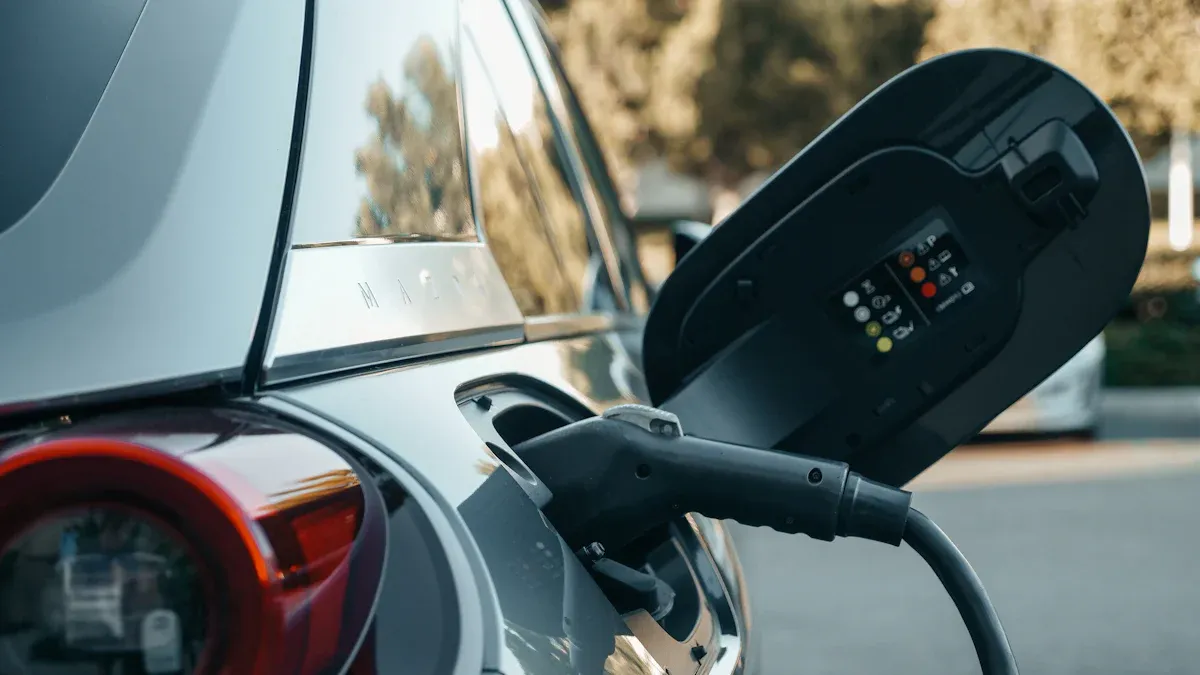
You need to use the correct battery charger for your device. A charger made for lithium-ion batteries uses a special charging process that matches the battery’s needs. Using a non-compatible charger, such as one made for lead-acid batteries, can cause fault codes and damage your battery, charger, or even other electronics in your system. Always choose a battery charger with a lithium-specific charge profile. If you cannot find one, select a charger with AGM, Gel, or sealed battery modes as a backup, but this is not ideal. The right charger helps you control voltage and keeps your battery safe.
Tip: Always check your device’s manual for the recommended battery charger and voltage settings.
Temperature Control
Temperature plays a big role in safe charging practices. Charging your battery in the right temperature range keeps it healthy and improves efficiency. Manufacturers recommend charging lithium-ion batteries between 5°C and 45°C. Charging below 0°C can cause lithium plating, which damages the battery. High temperatures above 45°C speed up aging and can cause swelling or even fires. Many battery chargers have built-in sensors to monitor temperature and adjust the charging process for safety.
| Temperature Range | Safety and Effects on Charging Lithium-ion Batteries |
|---|---|
| 5°C to 45°C | Recommended safe charging range; optimal charging efficiency and battery durability. |
| Below 5°C | Charging slows; risk of lithium plating and higher resistance. |
| Above 45°C | Risk of swelling, aging, and thermal runaway. Charging may stop or cause damage. |
Partial Charging
You can extend your battery’s life by using partial charging. Instead of always charging to 100%, try stopping at about 80% or using a voltage limit of 4.10V per cell. This method reduces stress on the battery and improves efficiency. Research shows that:
- Partial state of charge cycling leads to much longer battery life than full charge-discharge cycles.
- Cycle life increases as you reduce the depth of discharge.
- Partial charging can increase cycle life by up to 2.5 times.
- The main cause of battery aging is resistance growth in the solid-electrolyte interface.
You should also avoid keeping your battery at peak voltage for long periods. Follow your manufacturer’s guidelines for the best results. These steps help you get the most out of your battery while keeping the charging process safe and efficient.
Common Mistakes
Wrong Charger
You might think any charger will work for your device, but using the wrong battery charger is a common mistake. Many people use chargers that do not match the battery’s voltage or amperage. This can cause overcharge, overdischarge, or even damage the battery. Some chargers do not have the right protection features. Without these, you risk overheating, swelling, or even a fire. Consumer safety groups report that using counterfeit or uncertified chargers often leads to battery failures. Always use the battery charger recommended by your device’s manufacturer.
Tip: If you notice your charger or battery getting hot, unplug it right away and check for damage.
Ignoring Limits
Ignoring voltage limits is another mistake that can shorten battery life or cause dangerous problems. When you ignore the manufacturer’s charging limits, you increase the risk of overcharge and overdischarge. Overcharging stresses the battery and can lead to thermal runaway, which sometimes causes explosions. Overdischarge detection is just as important. If you let the battery drain too much, it can lose capacity or stop working. Many real-world incidents, like fires in phones and hoverboards, happened because people ignored voltage limits or used poor-quality chargers.
Here are some common errors:
- Overcharging by leaving devices plugged in overnight.
- Ignoring warning signs like swelling or strange smells.
- Charging damaged or swollen batteries.
- Not using overdischarge detection systems.
Alert: Always follow the voltage and current limits set by the manufacturer. Overdischarge detection and protection help keep your battery safe.
Extreme Conditions
Charging your battery in extreme conditions can cause serious damage. High heat or freezing temperatures harm the battery and make overcharge and overdischarge more likely. Charging below freezing can cause lithium plating, while high temperatures speed up aging and increase the risk of swelling. Overdischarge detection systems may not work well in these conditions. Exposing batteries to moisture or mechanical stress also increases the risk of failure.
- Never charge your battery near heat sources or in direct sunlight.
- Do not charge in very cold places.
- Avoid charging on beds, sofas, or other soft surfaces that trap heat.
Note: Overdischarge detection and protection are critical in extreme conditions. They help prevent battery failure and keep you safe.
You can keep your li-ion battery safe and long-lasting by following the latest li-ion battery charging best practices. Always use chargers designed for li-ion batteries, respect maximum voltage, and rely on overcharge protection. Avoid overcharge, deep discharge, and high temperatures. Store your battery at 40-60% charge in a cool, dry place. Overcharge protection and smart charging habits help prevent damage and improve safety. For quick answers to common questions about li-ion battery charging, check the FAQ section.
FAQ
How often should you charge your li-ion battery?
You should charge your li-ion battery when it drops to about 20%. Try not to let it reach 0%. Charging before it gets too low helps your battery last longer.
Can you leave your device plugged in overnight?
You should avoid leaving your device plugged in overnight. Most modern devices have protection, but staying at full charge for hours can stress the battery and shorten its life.
What happens if you overcharge or overdischarge a li-ion battery?
Overcharge can cause swelling or fire. Overdischarge can make your battery lose capacity or stop working. Always use devices with built-in protection to avoid these problems.
Is it safe to use your device while charging?
You can use your device while charging, but it may heat up more. If you notice your device getting hot, unplug it and let it cool down.
How should you store a li-ion battery for a long time?
Store your battery at about 40-60% charge in a cool, dry place. Avoid full charge or deep discharge before storage. This helps prevent overdischarge and keeps your battery healthy.