What is Incoterms® 2020? Definition, Key Rules, and Export Applications

One-Sentence Definition
Incoterms® 2020 are a set of 11 internationally recognized rules published by the International Chamber of Commerce (ICC) that define the responsibilities, costs, and risks for buyers and sellers in international sales contracts.
Detailed Explanation
Incoterms® 2020 (International Commercial Terms) clarify who is responsible for each step in the shipping process—such as transport, insurance, customs clearance, and risk of loss—when goods are sold across borders. These rules are not a substitute for a sales contract, nor do they determine when ownership passes or how payment is made. Instead, they provide a common language for global trade, reducing misunderstandings and disputes. The 2020 revision introduced clearer cost allocation, updated insurance requirements, and renamed DAT to DPU, reflecting modern logistics practices (ICC official).
Key Components of Incoterms® 2020
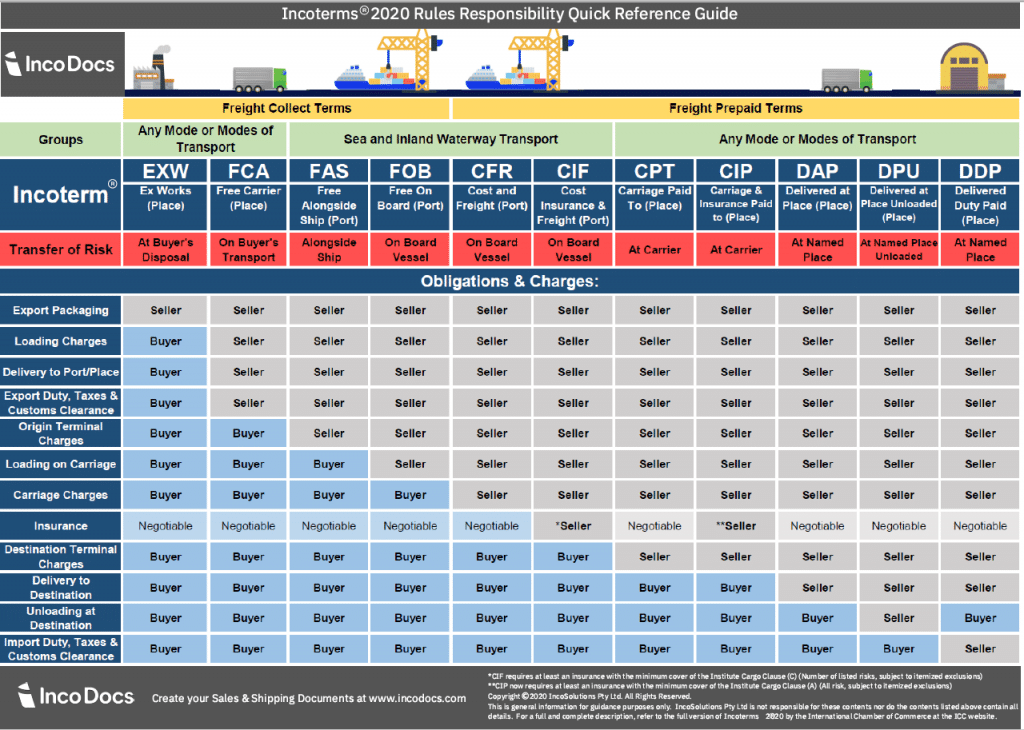
Incoterms® 2020 are divided into two groups:
- For any mode of transport:
- EXW (Ex Works)
- FCA (Free Carrier)
- CPT (Carriage Paid To)
- CIP (Carriage and Insurance Paid To)
- DAP (Delivered at Place)
- DPU (Delivered at Place Unloaded)
- DDP (Delivered Duty Paid)
- For sea and inland waterway transport:
- FAS (Free Alongside Ship)
- FOB (Free on Board)
- CFR (Cost and Freight)
- CIF (Cost, Insurance, and Freight)
Each rule specifies:
- Who arranges and pays for transport and insurance
- Where risk transfers from seller to buyer
- Who handles export/import customs clearance
For example, under FOB, the seller delivers goods on board the vessel at the port of shipment, and risk transfers to the buyer at that point. Under CIF, the seller also arranges and pays for insurance and freight to the destination port (IncoDocs Guide).
Practical Applications: Manufacturing & Export Example
For manufacturers like Toyin Acrylic Products Co., Ltd. (TOYIN), Incoterms® 2020 are essential in structuring export deals. Suppose TOYIN exports custom acrylic display stands to a European client:
- CIF Hamburg: TOYIN arranges and pays for shipping and insurance to Hamburg port. Risk transfers to the buyer once goods are loaded on the vessel in China, but TOYIN covers costs up to the destination port.
- FOB Shenzhen: TOYIN delivers goods on board at Shenzhen port. The buyer arranges shipping and insurance from there, taking on risk and cost from the moment goods are loaded.
Choosing the right Incoterm impacts cost, risk, and logistics control. For containerized goods, FCA is often preferred over FOB, as it better matches modern shipping practices. Always specify the exact term, location, and edition year in contracts to avoid disputes.
Common Misunderstandings
- Incoterms do not determine transfer of ownership (title); this is set by the sales contract.
- FOB is not ideal for containerized cargo; use FCA instead.
- DDP places maximum responsibility on the seller, including import duties and taxes, which can be risky if the seller is unfamiliar with the destination country’s regulations.
- Always specify the place/port and Incoterms edition (e.g., Incoterms® 2020) in contracts.
For more on common mistakes, see ICC Academy’s guide.
Related Concepts
- FOB (Free on Board): Seller delivers goods on board the vessel; risk transfers at loading.
- CIF (Cost, Insurance, and Freight): Seller covers shipping and insurance to the destination port.
- DAP (Delivered at Place): Seller delivers to a named place, ready for unloading.
- EXW (Ex Works): Buyer takes on all costs and risks from the seller’s premises.
- FCA (Free Carrier): Seller delivers to a carrier or location named by the buyer—ideal for containerized goods.
For a full visual breakdown, see this Incoterms® 2020 infographic.
TOYIN supports global brands and retailers with high-quality, custom acrylic products and flexible export solutions. Learn more about our international shipping and custom manufacturing at TOYIN Acrylic Products Co., Ltd..