What Are FOB, CIF, and EXW? Definitions, Key Differences, and Practical Applications

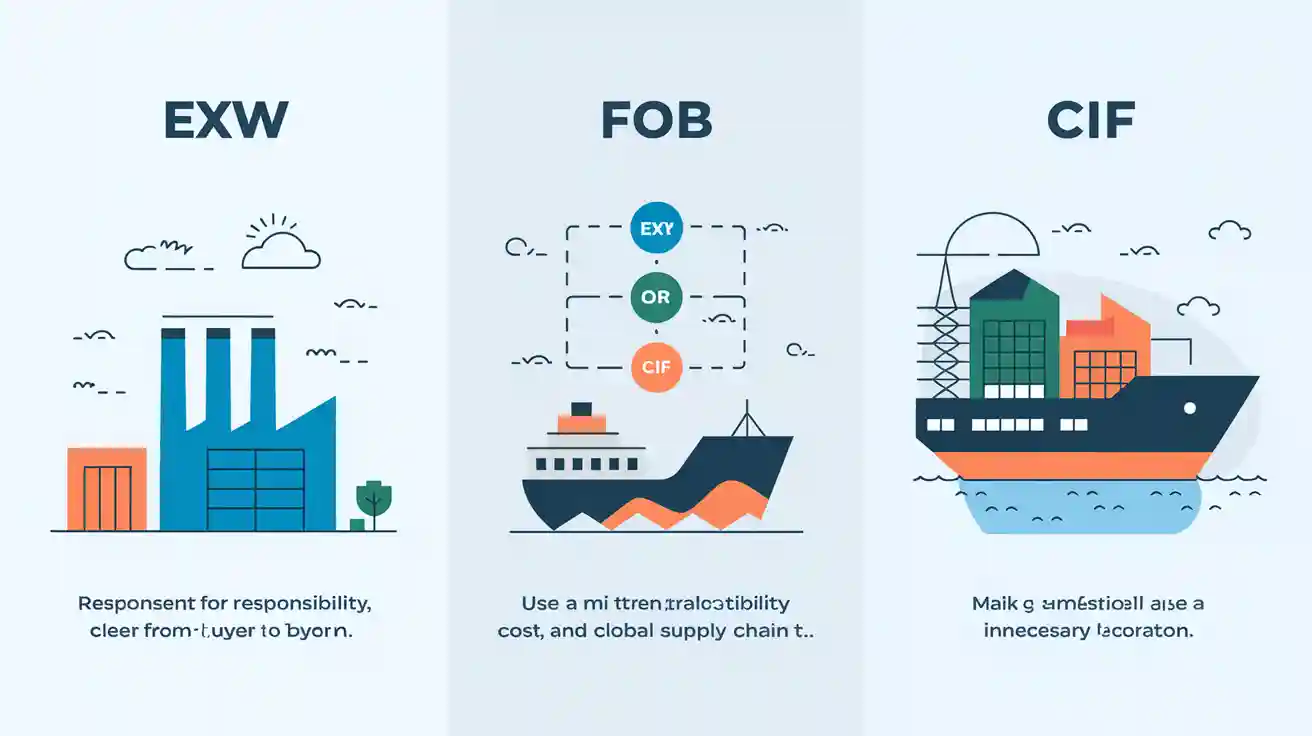
One-Sentence Definitions
- FOB (Free on Board): The seller delivers goods on board the vessel at the named port of shipment; risk and cost transfer to the buyer once loaded (ICC).
- CIF (Cost, Insurance and Freight): The seller delivers goods on board, pays for sea freight and insurance to the destination port; risk transfers to the buyer once goods are on board (ICC Academy).
- EXW (Ex Works): The seller makes goods available at their premises; the buyer bears all costs and risks from that point onward (ICC Academy).
Detailed Explanation
These three Incoterms—FOB, CIF, and EXW—are international trade rules published by the International Chamber of Commerce (ICC) to clarify the division of responsibilities, costs, and risks between buyers and sellers. They are essential for structuring contracts and logistics in global trade, especially for manufacturers and exporters.
- EXW places almost all responsibility on the buyer, who must handle transport, export, import, and insurance from the seller’s door.
- FOB splits responsibility at the port of shipment: the seller handles export and loading, while the buyer arranges sea freight, insurance, and import clearance.
- CIF requires the seller to pay for sea freight and insurance to the destination port, but risk still transfers to the buyer once goods are loaded on the vessel.
A simple analogy: EXW is like picking up a package yourself from the seller’s warehouse; FOB is like the seller delivering it to the port and loading it onto the ship; CIF is like the seller not only loading the ship but also paying for shipping and insurance to your port.
Key Components and Comparison Table
| Term | Seller’s Responsibility Ends | Who Pays Freight? | Who Pays Insurance? | Risk Transfers |
|---|---|---|---|---|
| EXW | Seller’s premises | Buyer | Buyer | At seller’s door |
| FOB | On board at port of shipment | Buyer | Buyer | On board ship |
| CIF | On board at port of shipment | Seller | Seller | On board ship |
For a visual summary, see this Incoterms infographic.
Practical Application: TOYIN’s Export Example
Suppose Toyin Acrylic Products Co., Ltd. (TOYIN) manufactures custom acrylic display racks for a European client. If the contract uses CIF, TOYIN arranges sea freight and insurance to the client’s port, reducing the buyer’s logistics burden and providing cost predictability. If FOB is chosen, TOYIN delivers the goods on board at the Chinese port, and the buyer manages shipping and insurance. With EXW, the buyer must handle all logistics from TOYIN’s factory in Dongguan, China, including export clearance and inland transport.
Choosing the right term affects not only cost but also risk management and operational complexity. For most international buyers, FOB or CIF offers a balance between control and convenience, while EXW is best for those with strong logistics capabilities or for domestic transactions.
Related Concepts
- Incoterms: The full set of international trade terms.
- FCA (Free Carrier): Often better than FOB for containerized goods.
- CFR (Cost and Freight): Like CIF but without seller-paid insurance.
- DDP (Delivered Duty Paid): Seller bears all costs and risks to the buyer’s door, including import duties.
Conclusion & Next Steps
Understanding FOB, CIF, and EXW is crucial for anyone involved in international trade, especially in manufacturing and custom product exports. The right choice can optimize costs, reduce risks, and streamline your supply chain.
Looking for a reliable partner for custom acrylic products with global shipping? Learn more about TOYIN’s export solutions.