Calculating Total Landed Cost Air vs Sea

You face a choice for your hotel's acrylic displays: a cheap sea freight quote or a fast air freight quote. The initial freight rate is misleading. Your true total cost depends on many factors. Recent air freight rates show this volatility.
| Metric | Change (Q1 2025) |
|---|---|
| Baltic Air Freight Index (BAI00) | ↑ 12.8% Year-over-Year |
| South Asia-Europe Rates | ↑ 70% |
Meanwhile, projections for ocean freight demand show more modest growth. To make a smart freight comparison of air vs ocean freight, you must calculate all total landed costs. Shipping by air involves different fees than ocean freight. This is the only way to see the real landed cost for your air shipping.
Your Essential Formula Total Landed Cost = Product Cost + Shipping + Customs + Risk + Overhead
Understanding Total Landed Cost Components
Your total landed cost is more than just the freight price. You must break down every charge to see the full picture. This helps you compare air freight and ocean freight accurately. Let's examine each part of the formula.
1. Base Freight Rates
The base freight rate is the fundamental cost of moving your goods from Port A to Port B. This is the number you see on an initial quote. It often creates a big, but deceptive, difference between air and sea options.
For air freight, the cost depends on weight. Express freight services like DHL or UPS are great for small shipments up to 150 kg, costing around $5 per kilo. For larger shipments between 150 kg and 500 kg, standard air freight is a cheaper option at about $3 per kilo.
Note: Rates for air freight from China to the USA can vary. Standard air freight averages $5–$8 per kilogram, while express services can be $8–$12 per kilogram.
Here is a general look at air express rates by weight:
| Weight Range (KG) | Rate Per KG (USD) |
|---|---|
| 0.5-5.5 | $4.65 – $17.36 |
| 6-11 | $8.82 – $14.73 |
| >70 | $3 – $3.4 |
In contrast, Less-than-Container Load (LCL) sea freight appears much cheaper upfront. Current estimates for LCL ocean freight from China to the USA are between $8 and $15 per cubic meter or kilogram. This low initial price is why many shippers are tempted by sea, but it's only the beginning of the total costs.
2. Ancillary & Port Fees
Ancillary fees are the extra charges that freight forwarders add for handling your shipment. These costs are where the price gap between air and sea starts to shrink.
With air freight, these fees are often lower because the process is faster and involves less handling. However, poor preparation for security screening can cause delays and extra charges for inspection or storage.
With sea freight, especially LCL, the list of fees is much longer. LCL cargo requires more handling than full containers, which increases costs. Your shipment is loaded into a container with others at the origin port and unloaded at the destination port. Each step has a fee.
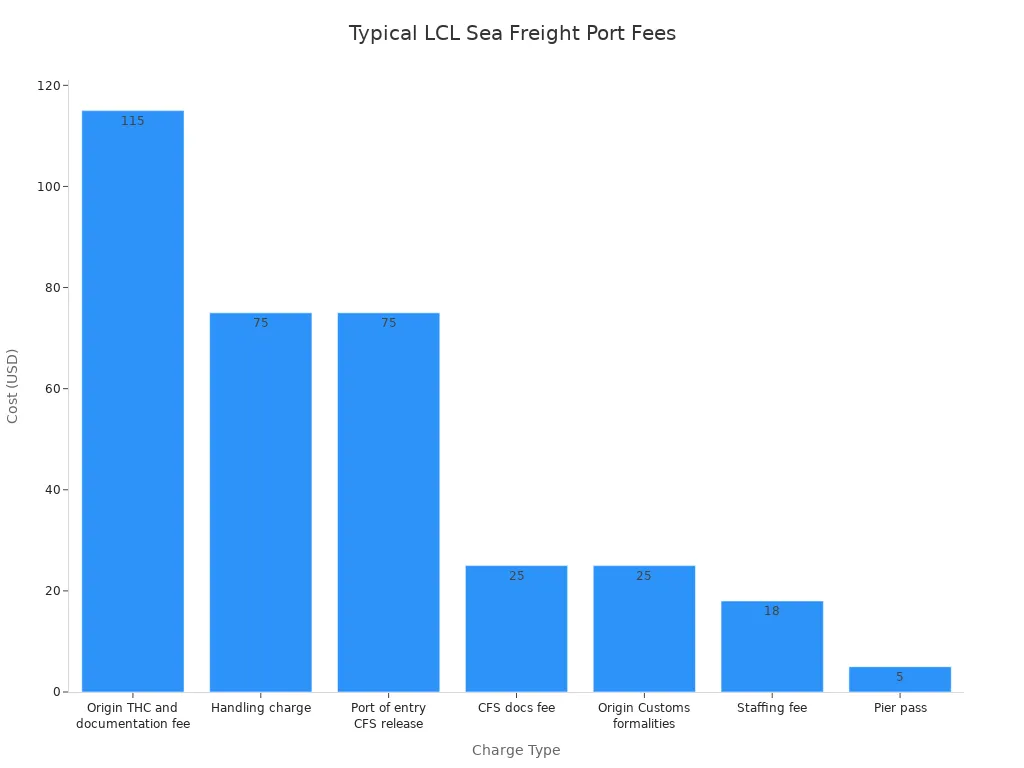
These ocean freight fees can add hundreds of dollars to your final bill. Common charges include:
- Terminal Handling Charges (THC): Fees from the terminal operator for loading, unloading, and storage.
- Documentation Fees: Charges for the Bill of Lading (B/L) and other paperwork.
- CFS Fees: Charges at the Container Freight Station where your LCL cargo is processed.
3. Customs, Duties, & Taxes
Every international shipment must clear customs. You are responsible for paying any duties and taxes required by the destination country. This cost is a percentage of your goods' total value, including the freight cost.
The duty amount depends on the product's Harmonized System (HS) Code. For your acrylic displays, the HS Code is likely 3926.90 for "other plastic articles."
Let's imagine your displays have a value of $3,000, including shipping. If the U.S. duty rate for that HS code is 10%, your calculation is simple:
$3,000 (Product Value + Shipping) x 10% (Duty Rate) = $300 (Import Duty)
This $300 is a mandatory part of your total landed cost, whether you ship by air or sea. You can use online calculators to estimate duties for your specific products.
4. Risk & Overhead Costs
Protecting your investment against damage or loss during transit is crucial. This is where cargo insurance comes in. While optional, shipping without it is a significant risk. Insurance is a key overhead cost.
The insurance premium is calculated based on the total value of your goods plus the freight cost. A common industry practice is to insure for 110% of this value to cover any extra expenses from a loss.
Here is how you can calculate your insurance premium:
- Find Your Insured Value: (Cost of Goods + Freight Cost) x 1.10
- Calculate the Premium: Insured Value x Insurance Rate (e.g., 0.5%)
For example, if your goods cost $10,000 and ocean freight is $2,000, your insured value is $13,200. With a 0.5% rate, your insurance premium would be $66. This formula is often associated with sea freight Incoterms like CIF (Cost, Insurance, and Freight), which only apply to shipments by ocean or waterway. A similar principle applies to air freight, ensuring your goods are protected until final delivery.
A Practical Freight Comparison
Theory is helpful, but seeing the numbers in action makes the choice clear. Let's apply the total landed cost formula to a real-world scenario. This practical freight comparison will show you exactly how hidden fees can change your decision between air vs ocean freight.
The Hypothetical Shipment
Imagine you are importing a shipment of acrylic displays for your hotel lobby. Here are the details of your shipment:
- Product: Acrylic Displays
- Commercial Value: $10,000
- Cargo Size: 2 Cubic Meters (CBM)
- Cargo Weight: 350 kg
- Origin: Shanghai, China
- Destination: A hotel warehouse in Los Angeles, USA
You have received two initial quotes: one for fast air freight and one for cheap sea freight. Now, you will build the full picture.
Side-by-Side Cost Analysis
Here is a detailed breakdown of every potential cost for your shipment. Notice how the initial freight price is only one piece of a much larger puzzle. The final landed cost tells the true story.
| Cost Component | Air Freight | Sea Freight (LCL) | Notes |
|---|---|---|---|
| Product Cost | $10,000 | $10,000 | This is the fixed value of your goods. |
| Base Freight | $3,200 | $195 | The initial quote. Air freight appears much more expensive. |
| Ancillary & Port Fees | $150 | $550 | Sea freight has higher handling, documentation, and CFS fees. |
| Customs Bond | $65 | $55 | A single entry bond is required. The cost is ~$5 per $1,000 of value. |
| Import Duty (5%) | $660 | $510 | Calculated on (Product + Freight Cost). The higher air freight cost increases the duty. |
| Cargo Insurance (0.5%) | $73 | $56 | Calculated on 110% of (Product + Freight Cost). |
| Inland Delivery | $250 | $450 | Air freight requires local delivery. Ocean freight needs port drayage, which costs more. |
| Total Landed Cost | $14,398 | $11,821 | The final, all-inclusive cost to get the goods to your warehouse. |
Interpreting the Final Numbers
At first glance, the base freight quote shows a massive difference of over $3,000. This makes the sea option seem like the obvious winner. However, the side-by-side analysis reveals a more complex reality for your air shipping.
The cheap sea freight quote quickly grew with additional costs:
- Port Fees: You added $550 in various handling and documentation fees that are minimal with air freight.
- Inland Delivery: You needed to pay $450 for drayage to move the cargo from the Port of Los Angeles. The local delivery from the airport was only $250.
- Other Fees: Smaller costs for insurance and customs bonds also added to the total.
The Real Difference The initial $3,005 gap in base freight shrank to a final difference of only $2,577 in total landed cost. The ocean freight option is still cheaper, but the savings are not as dramatic as the initial quote suggested. This smaller gap makes you question if the savings are worth the extra transit time.
This freight comparison shows why you must look beyond the initial price. The total landed cost for both air and sea gives you the data to make a confident decision based on your budget and your deadline.
The Final Verdict: Air vs Ocean Freight
Your total landed cost calculation gives you the power to decide. Now you can make an informed choice in the air vs ocean freight debate. The right option depends entirely on your priorities: speed, budget, or cargo size.
The Case for Air Freight vs. LCL
You should choose air freight when speed is your top priority. If your hotel opening is just weeks away, the extra cost of air freight is a smart investment. This is the key advantage of air freight vs. lcl.
Speed is Key ✈️ Standard door-to-door air freight from China to the US takes about 5-10 days. Express air services can deliver your goods in just 2-5 days. This speed makes air freight vs. lcl an easy choice for urgent shipments.
Consider air freight vs. lcl for:
- Urgent Deadlines: When you cannot afford delays from port congestion that are common with ocean freight.
- Small Shipments: If your cargo is under 2 CBM, the price difference between air freight vs. lcl narrows significantly.
- High-Value Goods: When the air freight cost is less than 15-20% of your product's value, the speed and reduced handling risk of air justify the expense. Ocean freight costs are typically much lower, but the transit time is longer. For air freight vs. lcl, you pay for speed.
When to Choose Sea Freight
You should choose sea freight when your budget is the main concern and your timeline is flexible. The lower base freight cost of ocean freight offers significant savings, especially for large shipments. This is the primary benefit of sea freight over air freight vs. lcl.
Sea freight is the ideal choice for:
- Large Shipments: For cargo over 2 CBM, sea freight is far more economical. The cost per unit decreases as your shipment size increases.
- Bulky or Heavy Items: Ocean freight can handle goods that are too large or hazardous for air travel. This includes items like furniture, machinery, and certain chemicals.
- Flexible Timelines: If you can wait 4+ weeks for delivery, the cost savings of sea freight are hard to beat. However, you must plan for potential delays. Port congestion and customs holds can add unexpected time to your sea journey.
Ultimately, the decision in the air vs ocean freight comparison comes down to balancing costs and time.
Remember the most important lesson: the cheapest freight quote rarely equals the lowest total landed cost. Use the cost components from this guide as your checklist for every international shipment. This turns abstract expenses into clear data for your air and sea freight decisions.
Your Final Step ✍️ Before you commit, empower yourself. Ask your freight forwarder for a complete, all-inclusive quote. This ensures you can accurately calculate your final cost for any air freight shipment and avoid hidden fees.
FAQ
What is the biggest cost difference between air and sea?
The base freight rate shows the biggest initial difference. Air freight quotes look much higher. You must add ancillary fees, customs, and delivery costs. These extra charges often make the final cost gap much smaller than you first thought.
How do I get an accurate freight quote?
You should ask your freight forwarder for an "all-inclusive" quote. This quote must list every single charge. It should include port fees, documentation, and inland delivery. This prevents surprise costs and helps you calculate the true total landed cost.
What is an HS Code? 🏷️
An HS Code is a number used by customs to classify your product. You need the correct HS Code to determine the import duty rate for your goods. Using the wrong code can cause expensive delays and fines.
Is air freight always best for small shipments?
Air freight is often best for shipments under 2 CBM, especially if they are urgent. You pay for speed and reliability. If your timeline is flexible, LCL sea freight might still save you money. Always compare the total landed cost.